
Media campaigns against underage drinking
Media campaigns utilize multiple mass media and digital media channels to increase awareness of underage drinking and its harmful consequences. Campaigns may be directed primarily at youth, and may also include efforts to provide parents and other adults with the knowledge and skills to take actions that help prevent underage drinking1, 2. Mass media campaigns can be run via a variety of channels, including TV, radio, magazines, newspapers, billboards, and banners. Digital media campaigns use digital platforms, including websites, social media, text messages, emails, podcasts, videos, and mobile applications3, 4.
What could this strategy improve?
Expected Benefits
Our evidence rating is based on the likelihood of achieving these outcomes:
Reduced underage drinking
Potential Benefits
Our evidence rating is not based on these outcomes, but these benefits may also be possible:
Increased adult awareness of underage drinking
What does the research say about effectiveness?
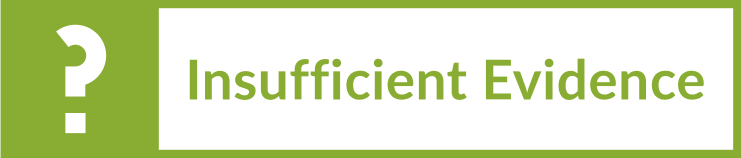
There is insufficient evidence to determine whether media campaigns against underage drinking reduce alcohol use among youth5, 6. Available evidence suggests that mass media campaigns may increase adolescents’ knowledge or alter perceived social norms about alcohol use in some circumstances, but have little or no effect on alcohol consumption among youth6. An evaluation of a national media campaign reported mixed effects on alcohol use; for youth ages 15-18, increased campaign awareness was associated with reductions in binge drinking, though such awareness was associated with accelerated alcohol use among youth ages 12-147. Additional evidence is needed to confirm effects6.
Experts suggest that mass media campaigns that increase adult awareness of underage drinking may reduce underage drinking1. Effects of increased parental knowledge on their monitoring and supervision regarding youth alcohol use are unclear1. Multicomponent interventions incorporating media campaigns may increase awareness of underage drinking and law enforcement implementation among youth8 and reduce initiating alcohol use among Native American youth9.
Media campaigns against alcohol use among college students, including underage drinkers, are likely to reduce binge drinking in some circumstances10, 11 and encourage bystanders to step in and help intoxicated peers12. However, a German-based study suggests that media campaigns can have adverse effects depending on the content displayed. The study indicates that young male university students are more likely to idealize social drinking situations and increase binge drinking after exposed to a responsible drinking campaign that features sociable drinkers13.
Components of effective social media campaigns for behavior change include community engagement, highly visible layouts, clear campaign messages, an understanding of the audience’s literacy skills, and avoiding content overload14, 15.
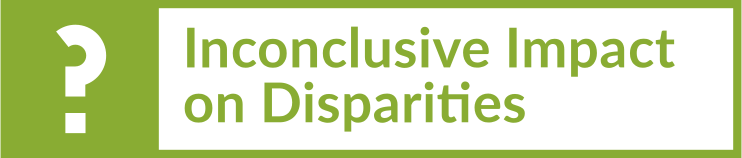
How could this strategy advance health equity? This strategy is rated inconclusive impact on disparities.
There is insufficient evidence to determine whether media campaigns against underage drinking reduce disparities in alcohol use among children and youth.
Available evidence suggests that a school-based culturally adapted media campaign paired with role modeling and educational activities can reduce initiation of alcohol use among Native American middle school students9. Researchers recommend adapting the context and messages of media campaigns to the culture and tribal traditions of Native American youth19.
What is the relevant historical background?
After the National Minimum Drinking Age Act was enacted in 1984, states passed statutes and regulations regarding underage possession, purchase, and consumption of alcoholic beverages to meet the federal highway funding requirements25. Governments, community coalitions, and organizations have initiated cooperative efforts to prevent underage drinking8.
In the U.S. and other countries, alcohol industry-sponsored advertisements often include visuals of alcohol consumption that lead to the sales of alcohol, normalization of alcohol use, and idealizing alcohol consumption in social events26. Youth exposure to alcohol media marketing can increase the risk of underage drinking27. Experts recommend federal, state, and local governments exercise their regulatory power to implement standards for alcohol marketing content and to fund health promotion media campaigns28.
Equity Considerations
- Which age groups are most affected by underage drinking in your community? Who needs to be reached by media campaigns (e.g., high school students, their parents)?
- How can you engage youth and their parents in campaign design? Who can you partner with in your community (e.g., organizations, schools, local leaders)?
- How do neighborhood conditions, stigma, and other systematic barriers prevent youth from adopting and sustaining health behaviors in your community? What additional strategies can be implemented to overcome those barriers?
Implementation Examples
There are a variety of media interventions implemented throughout the country. Some examples include Talk. They Hear You.2, Parents Who Host Lose the Most16, and Alcohol: True Stories17. Be Under Your Own Influence is a culturally modified substance use prevention campaign for Native American middle school students utilizing visual media such as banners and posters18, 19.
Examples of statewide media campaigns are Drunken Rewind in Florida20, Look. Listen. Love. in North Dakota21, the Know When. Know How. campaign in Pennsylvania22, Don’t Let Alcohol Ruin the Holidays, a social media campaign in Tennessee23, and Small Talks in Wisconsin24.
Implementation Resources
‡ Resources with a focus on equity.
SAMHSA-Talk - Substance Abuse and Mental Health Services Administration (SAMHSA). Talk. They Hear You.
SAMHSA-Communities Talk - Substance Abuse and Mental Health Services Administration (SAMHSA). Communities talk to prevent alcohol and other drug misuse: Tips and resources.
Footnotes
* Journal subscription may be required for access.
1 IOM-Underage drinking 2004 - Institute of Medicine (IOM), National Research Council (NRC), Committee on Developing a Strategy to Reduce and Prevent Underage Drinking, Board on Children, Youth, and Families (BCYF). Reducing underage drinking: A collective responsibility. (Bonnie RJ, O’Connell ME, eds.). Washington, D.C.: National Academies Press; 2004.
2 SAMHSA-Talk - Substance Abuse and Mental Health Services Administration (SAMHSA). Talk. They Hear You.
3 Sharma 2022 - Sharma, S., Mohanty, V., Balappanavar, A. Y., Chahar, P., & Rijhwani, K. (2022). Role of digital media in promoting oral health: A systematic review. Cureus, 14(9), e28893.
4 Evans 2022a - Evans, W. D., Abroms, L. C., Broniatowski, D., Napolitano, M. A., Arnold, J., Ichimiya, M., & Agha, S. (2022). Digital media for behavior change: Review of an emerging field of study. International Journal of Environmental Research and Public Health, 19(15), 9129.
5 Jackson 2018 - Jackson, K. M., Janssen, T., & Gabrielli, J. (2018). Media/marketing influences on adolescent and young adult substance abuse. Current Addiction Reports, 5(2), 146–157.
6 Young 2018a - Young B, Lewis S, Katikireddi SV, et al. Effectiveness of mass media campaigns to reduce alcohol consumption and harm: A systematic review. Alcohol and Alcoholism. 2018;53(3):302-316.
7 Scheier 2010 - Scheier LM, Grenard JL. Influence of a nationwide social marketing campaign on adolescent drug use. Journal of Health Communication. 2010;15(3):240-271.
8 Harding 2016 - Harding, F. M., Hingson, R. W., Klitzner, M., Mosher, J. F., Brown, J., Vincent, R. M., Dahl, E., & Cannon, C. L. (2016). Underage drinking: A review of trends and prevention strategies. American Journal of Preventive Medicine, 51(4), S148–S157.
9 Crabtree 2021 - Crabtree, M. A., Stanley, L. R., Kelly, K. J., & Swaim, R. C. (2021). Be Under Your Own Influence: Effectiveness of a culturally-adapted drug prevention campaign targeting reservation-dwelling American Indian youth. Journal of Community Psychology, 49(7), 2316–2329.
10 Yeh 2023 - Yeh, J-C., Niederdeppe, J., Lewis., N. A. Jr., & Jernigan, D. H. (2023). Social media campaigns to influence alcohol consumption and related harms, attitudes, and awareness: A systematic review. Journal of Studies on Alcohol and Drugs, 84(4), 546–559.
11 Hembroff 2021 - Hembroff, L. A., Martell, D., Allen, R., Poole, A., Clark, K., & Smith, S. W. (2021). The long-term effectiveness of a social norming campaign to reduce high-risk drinking: The Michigan State University experience, 2000–2014. Journal of American College Health, 69(3), 315-325.
12 Schipani-McLaughlin 2022 - Schipani-McLaughlin, A. M., Salazar, L. F., Muilenburg, J. L., Lauckner, C., Swartzendruber, A., & Walters, D. (2022). A mixed media campaign to promote bystander intervention and reduce alcohol use among college students: A pilot study. Health Promotion Practice, 23(6), 1033–1041.
13 Zimmermann 2017 - Zimmermann, F., Kohlmann, K., Monter, A., & Ameis, N. (2017). The social image of drinking - mass media campaigns may inadvertently increase binge drinking. Psychology, Health & Medicine, 22(9), 1032–1044.
14 Suryani 2024 - Suryani, A. (2024). Digital dialogues: Analyzing the impact of social media on the effectiveness of public health campaigns. Social Communication, 25(1), 2450-7563.
15 Dadgostar 2025 - Dadgostar, P., Qin, Q., Cui, S., Ashcraft, L. E., & Yousefi-Nooraie, R. (2025). Using social media to disseminate behavior change interventions: Scoping review of systematic reviews. Journal of Medical Internet Research, 27, e57370.
16 PAA-Parents who host - Prevention Action Alliance (PAA). Parents who host lose the most.
17 NREPP-ATS - SAMHSAH's National Registry of Evidence-based Programs and Practices (NREPP). (2011). Alcohol: True Stories Hosted by Matt Damon.
18 BUYOI-AI - Native Communities - Alcohol Intervention Review (NativeAIR). (n.d.). Be Under Your Own Influence (BUYOI-AI). Retrieved July 8, 2026.
19 Stanley 2018 - Stanley, L. R., Kelly, K. J., Swaim, R. C., & Jackman, D. (2018). Cultural adaptation of the Be Under Your Own Influence media campaign for middle-school American Indian youth. Journal of Health Communication, 23(12), 1017–1025.
20 Gallegos-Jeffrey 2025 - Gallegos-Jeffrey, A., Barth, C., Smith, S., McDowell, T., Janzen, T., Smyser, J., & Bonnevie, E. (2025). Examining engagement and responses to a digital binge drinking campaign for young males in Florida. Journal of American College Health, 73(5), 2213–2218.
21 Parents Lead-Campaign - North Dakota Department of Health and Human Services. (2024). Parents lead community resource guide.
22 PLCB Report 2024 - Pennsylvania Liquor Control Board (PLCB). (2024, December). Annual report fiscal year 2023-24.
23 TN-Campaign - Tennessee Alcohol Beverage Commission. (2023, November). Tennessee launches campaign to promote safe alcohol use during holidays. Retrieved July 8, 2026.
24 WI DHS-Small talks - Wisconsin Department of Health Services (WI DHS). (2026, February). Small talks: How WI prevents underage drinking. Retrieved July 8, 2026.
25 APIS-Underage drinking - Alcohol Policy Information System (APIS) (n.d.). Underage drinking. Retrieved July 8, 2026.
26 Vital Strategies 2025 - Vital Strategies. (2025). How the alcohol industry steers governments away from effective strategies to curb drink driving: Insights from advertising research (Research Paper No. RS034).
27 Zhang 2024 - Zhang, L. & Esser, M. (2024). U.S. adolescents’ exposure to alcohol marketing: Self-reported exposure on the internet and traditional media. AJPM Focus, 3(5),100243.
28 NASEM-Negussie 2018 - National Academies of Sciences, Engineering, and Medicine (NASEM). (2018). Interventions to reduce drinking to impairment. In Y. Negussie, A. Geller, & S. M. Teutsch (Eds.), Getting to zero alcohol-impaired driving fatalities: A comprehensive approach to a persistent problem (pp. 67–134). National Academies Press.
Related What Works for Health Strategies
To see all strategies:
countyhealthrankings.org/whatworks