How data sparks conversations about health and equity in the Bronx
For over two decades, Bronx Health REACH (BHR) has been a force for health equity in New York City’s most under-resourced borough. Led by the Institute for Family Health, this coalition of more than 80 organizations has worked to eliminate racial and ethnic health disparities in the Bronx. One of their most powerful tools? County Health Rankings & Roadmaps (CHR&R) data-informed Health Groups (formerly known as Rankings).
Health Groups illustrate the relative similarities in county health among Health Groups on a national scale. Health Groups support data-informed comparisons in county community conditions, as well as population health and well-being on a national scale. When CHR&R previously used ordinal rankings to order each county in a state from most to least healthy, Bronx County consistently ranked 62nd out of 62 counties in New York State — a stark reminder of the deep-rooted inequities facing the community.
In 2015, Bronx Health REACH and several key stakeholders in the Bronx launched #Not62: The Campaign for a Healthy Bronx, using CHR&R data as a rallying cry. “We’ve used the Rankings as a critical way to talk about it,” said Charmaine Ruddock, BHR’s project director. “This should be unacceptable.’”
This simple but powerful message has helped Bronx Health REACH “needle” policymakers—their word for persistent, strategic advocacy. “Others call it advocacy; we call it needling,” Ruddock explained. “To be incessant and insistent. To prod those who need to be prodded.”
CHR&R data have also helped the coalition educate the public. Many Bronx residents didn’t know their county’s health relative to others in the state. “It gave us a clear, easy-to-understand way to talk about the health of our community,” Ruddock said. “It helped us say, ‘Here’s where we are. Here’s what needs to change.’”
In 2021, Bronx Health REACH hosted a community event with CHR&R staff to celebrate improvements in some health behaviors and community conditions. “We were able to show where we moved from 50-something to 20-something in certain measures,” Ruddock said. “That was because of our efforts and partners’ efforts. The Rankings helped us tell that story.”
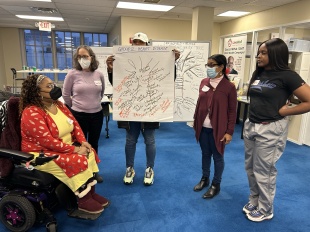
As CHR&R has shifted from ordinal rankings to data-informed Health Groups, Bronx Health REACH continues to use the data to push for change. “With the Health Groups, we see the opportunity to connect with other communities across the country who are in similar health groups. That opens the door for a national conversation.” In June 2025 Bronx Health REACH — partnering with the steering committee of the Not62: A Campaign for a Healthy Bronx, the National REACH Coalition and CHR&R — convened a meeting with organizations from communities in eight states, who shared similar challenging health outcomes and the determining community conditions. The goal of the meeting was to address these outcomes and to explore the possibility of joint efforts.
CHR&R has also helped Bronx Health REACH build credibility with funders, health systems and elected officials. “CHR&R comes with such authority,” Ruddock said. “When we use CHR&R data, it validates what we’re saying. It gives weight to our demands.”